
Publii vs Medium
Publii and Medium both make publishing easier, but only Publii creates an independent website that you can host, design and measure on your terms. Medium operates a reader network and browser-based editorial tools, while the publication itself remains on Medium's platform.
Download Publii free Compare with MediumQuick verdict
Use Publii as the publishing home. Choose Medium when its network is the priority.
For an independent blog, company publication or resource site, Publii is the stronger default: you choose the host, control the design and SEO settings, select the analytics stack and keep the generated website files. Medium is the better fit when platform distribution and a shared browser workflow matter more than control of the site.
Build the publication you control
For an owned blog, documentation site, portfolio or company publication with its own hosting, design, URLs and measurement stack.
Choose Medium for its network
For publishing inside Medium, eligibility for platform distribution, collaborative publications and access to Medium's engagement and monetization systems.
If you are deciding where a long-term publication should live, Publii is the independent alternative. Medium can still serve as an additional distribution channel.
Direct comparison
Publii vs Medium at a glance
Publii generates a complete website that you deploy to a host of your choice. Medium stores, hosts and presents your stories inside its own service, even when you connect a custom domain. That difference shapes nearly every tradeoff below.
| PubliiStatic CMS | MediumHosted platform | |
|---|---|---|
| Main purpose | Build an independent content website | Publish within an existing reader network |
| Software and publishing cost | The app is free and open source; domain, hosting, themes or services may still cost money | Writing from a personal profile is free; an active membership is required to create a publication or connect a custom domain |
| Hosting control | You choose and can change the host | Medium hosts the publication and controls the platform |
| Custom domain | Yes, through your own hosting configuration | Yes, with an active Medium membership; one domain per profile or publication |
| Design and code control | Themes, Handlebars templates, CSS and JavaScript can be customized; you also receive the generated site files | Layouts, header, logo, accent color and sections can be adjusted; custom scripts and Google Analytics are not supported |
| Built-in audience and distribution | No platform feed; you build traffic through search, links, email and your own promotion | Stories are eligible for distribution to followers, publication audiences, topic pages, digests and recommendation surfaces |
| Browser-based editorial team | Not built in; Publii is primarily a local desktop workflow | Built in through publication owners, editors, writers and submissions |
| Offline editing | Built in, including local preview | The normal writing workflow uses Medium's website or mobile app and saves drafts to the account |
| SEO control | Page titles, descriptions, robots directives, URLs, XML sitemap and social metadata are configurable | Canonical links and story preview settings are available, but Medium controls the technical platform and applies its own indexing thresholds |
| Analytics | Choose your own service, including supported Google Analytics, Matomo, Plausible and Umami integrations | Built-in story and audience statistics; no Google Analytics or arbitrary tracking scripts |
| Reader engagement | Comments and other community features use plugins or external services | Claps, highlights, responses, follows and email subscriptions are built in |
| Newsletter | Connect the email platform and signup flow you choose | Publications include a newsletter system for editors and publication subscribers |
| Monetization | You choose the business model and integrations | Eligible writers enrolled in the Medium Partner Program can earn from paywalled stories |
| Content portability | Local project backups plus deployable HTML, CSS, media and other site files | Medium lets you export personal data and stories as HTML files in a ZIP archive |
Medium features, eligibility rules and subscription prices can change because Medium operates the service. Publii is free software, but the cost and capabilities of an independent site also depend on the hosting, theme and third-party services you select.
The central difference
Publii gives you a website. Medium gives you a place within Medium.
Both products let you write an article, add images and press Publish. What happens after that is structurally different.
Publii builds the finished site on your computer. You select the theme, configure the URLs and publish static files to your own hosting account, object storage service, Git-based host or a local folder for manual deployment.
Medium publishes the story through Medium's infrastructure. You can use a medium.com address or connect a domain you own, but custom-domain pages remain hosted on Medium. You cannot add a proxy, inject your own scripts or turn that address into an independently operated Medium installation.
A custom domain changes the address. It does not change who runs the platform.
Publii publishing path
The CMS and the live website stay separate.
- Write and preview in the desktop app
- Generate the finished static site
- Deploy to the host and domain you choose
The public server receives website files, not the Publii application or its working project.
Medium publishing path
Writing, hosting and distribution share one platform.
- Write and save the draft in Medium
- Medium stores and hosts the story
- The platform may distribute it across its network
A custom domain can replace the visible address, but the story remains on Medium's platform.
Reach
Medium may add platform reach. Publii keeps the original on your domain.
An independent website begins without a built-in audience. Medium begins with a network, but distribution beyond your followers is not guaranteed.
Medium readers can follow writers, publications and topics. A published story may appear in follower feeds, email digests, Medium search, topic pages and recommendation surfaces. Stories accepted by an established publication can also reach that publication's followers.
That distribution can extend a story's circulation, but it is not guaranteed. Medium decides how its recommendation and indexing systems work. Medium's statistics FAQ says that a new writer may receive few or no presentations, especially without submitting the story to a publication.
Publii does not promise discovery. It gives you the technical base for earning it: a site on your domain, crawlable pages, direct links, an XML sitemap and the freedom to connect your preferred email, analytics and promotion tools.
Medium can add platform distribution. Publii keeps the original article and the traffic it earns on your domain.
Cost
Publii software is free. Medium membership is required for publications and custom domains.
A free Medium account can publish stories from a personal profile. Creating a publication or connecting a custom domain requires an active Medium membership.
| PubliiStatic CMS | MediumHosted platform | |
|---|---|---|
| Publishing software or account | $0 for the Publii app; free and open source | $0 to publish from a personal profile |
| Publication and custom-domain access | No Publii subscription; use the domain and hosting you arrange | Active Medium membership required; the standard plan is $5 per month or $50 per year |
| Hosting | Choose free or paid static hosting and change provider when needed | Included in the service; Medium hosts and controls the publication |
| Domain registration | Purchased separately if you want a custom domain | Purchased separately, in addition to the required membership |
Medium's standard membership price was checked on August 25, 2026. Domain, hosting, theme and third-party service prices depend on the providers you choose.
Publii itself is free under the GPL-3.0 license. A small static site can use free hosting, but a production budget may also include a domain, premium theme, storage, email service, analytics, comments or technical support.
Neither option is automatically cheaper for every publisher. Medium bundles infrastructure and platform features into one service. With Publii, the total depends on the hosting, domain, theme and external services you select.
Brand and structure
Medium keeps design constrained. Publii lets the publication become a full website.
Medium provides a consistent interface and a defined set of publication layout controls. Publii lets you replace or modify the theme and its code.
A Medium publication can have a logo, description, header image, accent color, navigation, subpages and configurable homepage sections. These controls can organize a magazine or company blog, but the result still uses Medium's publication system and templates.
Publii themes control the entire website. You can build custom landing pages, navigation systems, article templates, author archives and content sections, then edit the underlying Handlebars, CSS and JavaScript when the theme settings are not enough.
This distinction matters when the publication supports a wider business. Product pages, documentation, resources, campaign landing pages and a blog can all share one Publii site and design system. Medium is better treated as a publication channel than as a general-purpose company website.
With Publii, you control
The publication stack
Domain and hosting, themes and templates, site navigation, generated files, analytics provider, custom scripts, consent setup and the surrounding website.
That control also makes you responsible for configuration, backups, service selection and deployment credentials.
With Medium, the platform controls
The publication environment
Hosting, page templates, recommendation surfaces, supported embeds, analytics definitions, platform navigation, account rules and most of the reader experience.
You receive a consistent managed service and built-in network features, but fewer ways to change how the system works.
Editorial workflow
Medium simplifies distributed editing, but the workflow stays inside Medium
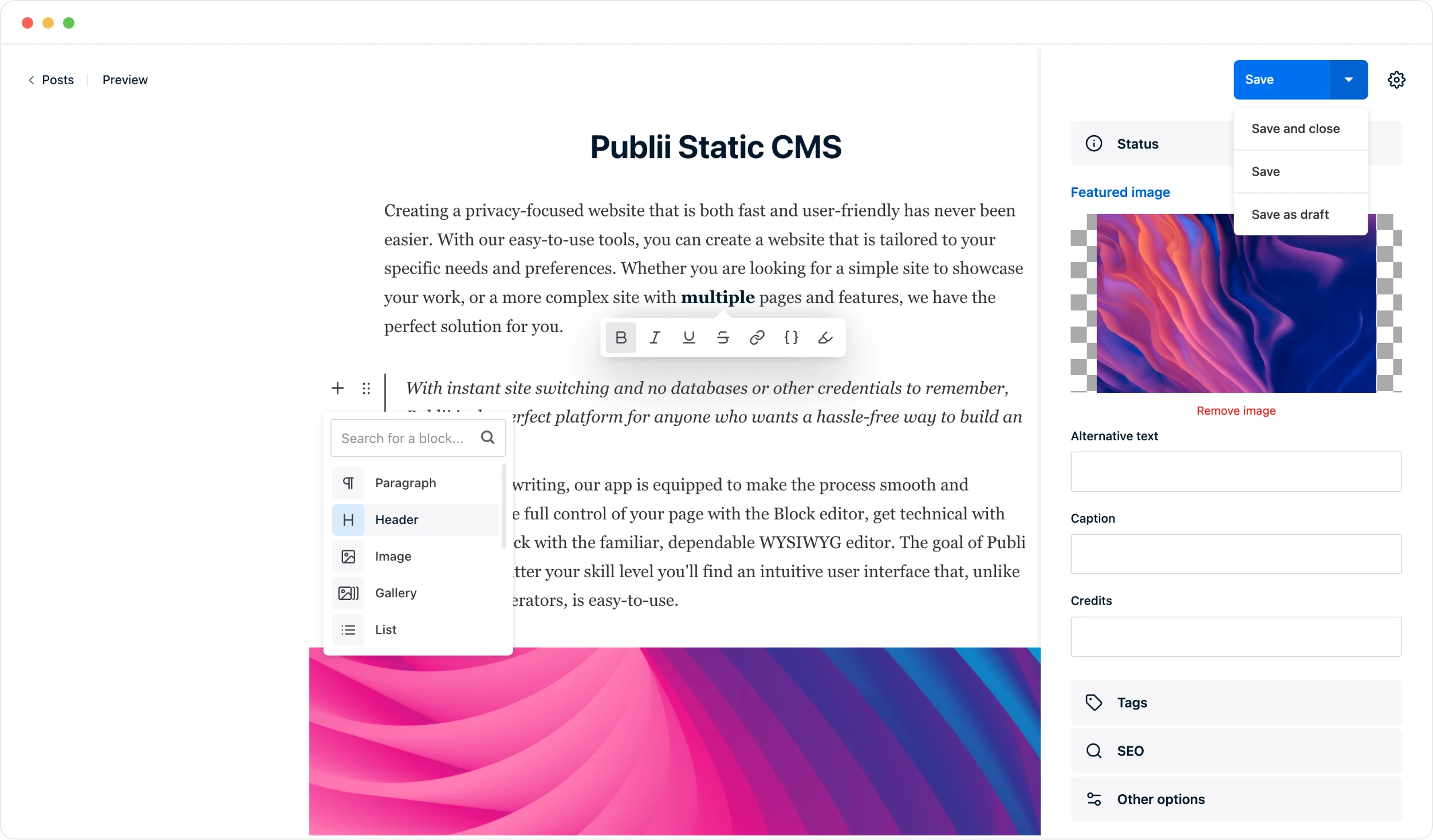
Publii supports multiple author profiles and assigns each post to an author, but its standard workflow is built around a desktop project rather than a shared browser dashboard.
Medium publications have an owner, editors and writers. Writers can submit drafts or published stories. Editors can review submissions, request changes, accept or reject work, publish stories, edit publication content and view publication statistics. That workflow is available anywhere the contributor can sign in.
Publii stores the working project locally, and a site backup can be restored on another computer. Simultaneous editorial collaboration is not its native model. Teams need their own process for handing off drafts, controlling the project copy and deciding who publishes.
Publii suits a single publisher or a team that can use a clear handoff. Medium provides shared roles and submissions for publications with many contributors.
SEO and distribution
Publii puts site-level SEO controls in your hands
Search visibility is possible with both. Publii exposes the site controls; Medium supplies the technical platform and decides which content is eligible for external indexing.
Publii's site settings cover page titles, meta descriptions, robots directives, URL patterns, pagination, XML sitemap content, Open Graph data and Twitter Card data. The generated HTML is deployed on the domain and host you choose.
Medium handles the page templates and technical delivery. Authors can set a canonical link when a story first appeared elsewhere, adjust its display title and subtitle, select topics and use a custom story URL. They cannot configure the platform's sitemap or install an SEO plugin.
Medium also limits which content it makes available to external search engines. Its help center says a new creator may need time to meet the internal quality threshold for indexing.
That does not make Medium unsuitable for search. It means the final indexing decision includes a platform-level filter the publisher does not control.
The hybrid option
You can publish on your own site first, then use Medium for distribution
Publii and Medium do not have to be mutually exclusive.
Publish the original article on your Publii site, where it becomes part of the domain and archive you control. Then use Medium's import tool to create a Medium version.
The import tool backdates the Medium story to the original publication date and automatically adds a canonical link pointing to the source. If the importer cannot read the page correctly, you can paste the article manually and set the canonical URL in the story's advanced settings.
This keeps the original URL as the canonical source while the Medium version remains eligible for distribution through publications, feeds and recommendations. Review the imported draft, including its formatting and media, before publishing.
In this workflow, Publii is the publishing home and Medium is an additional channel.
Owned-first distribution
One article, two channels, one canonical source.
- Publish the original on your Publii site
- Establish its permanent URL on your domain
- Import that URL into Medium and review the draft
- Keep the Publii URL as the canonical source
Medium becomes the distribution copy. Your Publii site remains the original home.
Analytics and audience data
Medium measures activity inside Medium. Publii lets you choose the measurement system.
Medium's built-in statistics report activity within its own distribution and engagement systems.
The Medium dashboard reports presentations, views, reads, followers and subscribers. Detailed story statistics can also show traffic sources, read ratio, claps, highlights, responses and Partner Program earnings where applicable.
Medium does not support Google Analytics or arbitrary scripts, including on custom domains. You receive the metrics Medium provides, using Medium's definitions.
Publii does not include a central hosted analytics dashboard. You can leave the site untracked or connect Google Analytics, Matomo, Plausible or Umami through supported plugins, with custom code available for other setups. Consent, configuration, data quality and regulatory compliance remain your responsibility.
Newsletter, community and revenue
Medium bundles audience features. Publii leaves the providers and business model to you.
A Medium publication can collect followers and newsletter subscribers, send newsletters, receive submissions and host reader responses without connecting a separate stack of services.
Eligible writers accepted into the Medium Partner Program can place stories behind Medium's paywall and earn according to member engagement. Participation requires an active Medium membership, at least one published story, a complete profile, age and location eligibility, and acceptance of the program terms.
Publii does not provide a native audience marketplace or revenue-sharing program. Advertising, sponsorships, affiliate links, paid downloads, memberships or subscriptions require compatible hosting, third-party services or custom integrations. You choose and operate that setup.
The same pattern applies to comments and email. Medium provides its own system. Publii supports several external comment services, while forms and newsletters require a service or custom integration selected by the publisher.
Maintenance and control
Publii avoids a live CMS without surrendering the hosting choice
Medium manages the hosting platform. Publii removes the need to run a live CMS on the host.
On Medium, you do not patch a CMS, configure a CDN or manage uptime. Medium handles those systems and can change their features, rules, pricing and distribution logic.
With Publii, you update the desktop app, theme and plugins, keep project backups and maintain access to your hosting account. The public website normally consists of static files, so there is no Publii login, application server or database to patch online.
Medium can change platform features, rules and distribution. If a Publii host or service no longer fits, you can deploy the site files elsewhere. Medium reduces infrastructure work; Publii preserves the choice of infrastructure.
Ownership and portability
You own the writing in both systems, but only one gives you the complete website
Medium's terms state that authors retain their rights to submitted content. Publishing there also grants Medium a license to display and distribute that content through its services.
Medium lets you export your stories as HTML files in a ZIP archive. That is a real exit path for the writing. It does not export the Medium platform, publication design, recommendation history or a standalone replacement for the hosted site.
A Publii project lives locally and can be saved as a restorable backup. The generated website is also a separate collection of ordinary files that can be moved to another compatible host.
Content ownership answers who holds the rights. Platform ownership answers who controls the place where the content is published. They are not the same question.
Common questions
Publii vs Medium FAQ
Does a custom domain turn Medium into an independent website?
No. The domain replaces the visible medium.com address for the profile or publication, but Medium still hosts the pages and applies its terms, features and technical restrictions.
Do you have to pay to write on Medium?
No. Medium says membership is not required to read or write. An active membership is required to create a Medium publication, connect a custom domain or apply to the Medium Partner Program.
Does Publii have a Medium importer?
No. Publii does not have a dedicated Medium importer. Medium can export stories as HTML files in a ZIP archive, but moving them to Publii is a manual process. The posts or pages, metadata, formatting and media must be recreated and checked in the Publii project.
Can you publish the same article with Publii and Medium?
Yes. Publish the original on the Publii site, then import its URL into Medium or set the canonical link manually. Check the imported draft before publishing because page-specific formatting and embeds may need adjustment.
Final decision
The practical recommendation: make Publii the publishing home
The permanent publishing home
Your own hosting, broad design control, configurable SEO, selectable analytics, local editing, portable site files and the freedom to combine the blog with a larger website.
A managed channel and network
A hosted editor, eligibility for Medium distribution, browser-based editorial roles, built-in engagement, newsletters and Partner Program eligibility.
If the goal is a durable brand or business asset, Publii is the better home: you control the domain, host, design, SEO setup, analytics choices and deployable site files.